
Riverbed Again Named a Leader in the 2026 GigaOm Radar for Network Observability
A shift is underway, and the 2026 GigaOm Radar for Network Observability confirms it.

- By Chuck Smith
- 05-May-2026
 Riverbed has been named a Leader and Fast Mover in the Innovation / Platform Play quadrant of the 2026 GigaOm Radar for Network Observability. This placement validates Riverbed’s strategy of full-fidelity visibility, unified data, and AI-driven intelligence – an approach that aligns with how GigaOm defines modern network observability.
The GigaOm Radar evaluates vendors based on execution, innovation, and platform maturity, not just features, giving NetOps teams a clear view of which solutions can meet the demands of modern environments.
This year’s report highlights a clear shift: observability has moved beyond monitoring. The report highlights a shift toward platforms that turn data into understanding and understanding into action.
Visibility Is the Foundation. Fragmentation Is the Barrier.
Network teams have done the hard part. Over the past decade, they’ve built out visibility across packets, flows, infrastructure, endpoints, and cloud environments. There is no shortage of data.
The problem is not a lack of data. It’s that most of it remains fragmented. Packet tools, flow monitors, infrastructure platforms, and endpoint solutions each provide a different version of reality. During incidents, teams don’t lack information – they’re reconciling conflicting answers.
That’s not an observability problem. That’s an architecture problem. The challenge is no longer collecting more data. It’s turning fragmented data into coherent, actionable insight.
How the GigaOm Radar Evaluates Platform Maturity
The Radar makes this shift explicit, moving away from device-centric monitoring toward platforms that combine end-to-end visibility with intelligence and action. The expectation is no longer just to collect telemetry, but to reduce the manual effort required to interpret and act on it.
To meet that standard, platforms must:
- Collect multiple telemetry types across the entire environment
- Correlate that data into a single, consistent view
- Apply intelligence to identify root cause and drive next actions
This is the difference between monitoring systems and decision systems. And it highlights a clear challenge in the market: fragmented telemetry produces fragmented insight, and the operator becomes the integration layer.
Why Riverbed Is Positioned as a Leader
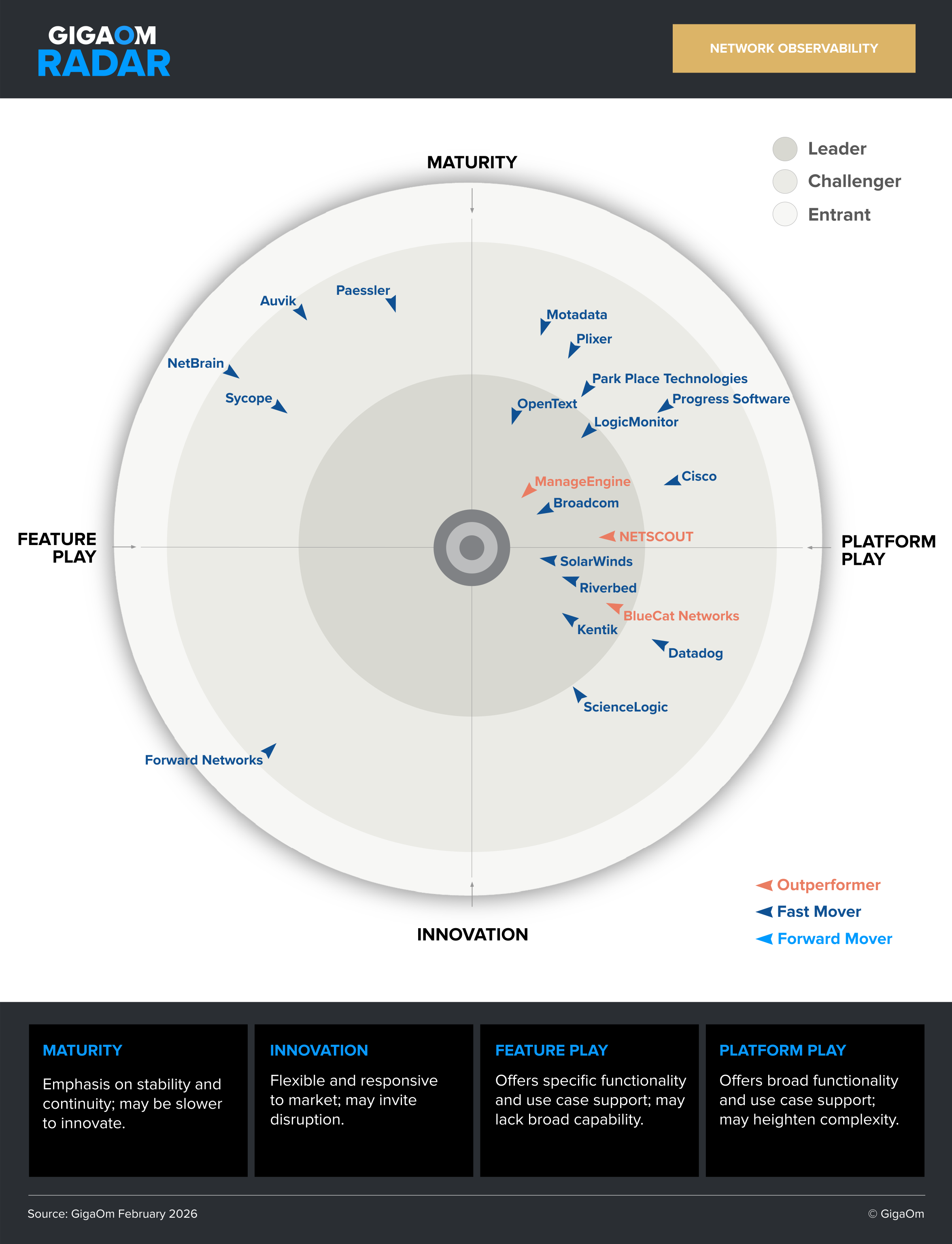
Riverbed’s position as a Leader and Fast Mover reflects more than alignment with market direction. It reflects a fundamentally different approach to solving the problem the Radar highlights.
This positioning is not incidental. It is the result of an architecture designed specifically to address the fragmentation that limits most observability platforms today.
At the core of the Riverbed platform is full-fidelity telemetry across packets, flows, infrastructure, and user experience, delivered not as separate tools, but as a unified system.
By contrast, parts of the market remain divided across incomplete approaches. Some vendors emphasize packet-level depth but struggle to scale or extend visibility. Others prioritize flow-based monitoring, trading precision for efficiency and scalability. Many claim to be platforms but still rely on loosely integrated components that require manual correlation.
Riverbed eliminates those tradeoffs by capturing and correlating:
- Packets for deep, ground-truth analysis
- Flows for scalable visibility and trends
- Infrastructure metrics for network and device health
- End-user experience data for real-world performance
These are not just multiple data sources. When pulled together in the Riverbed Data Store, they form a single, consistent model of how the network behaves.
That distinction becomes clear in real-world operations. Instead of stitching together partial answers from multiple tools, teams gain a unified view of cause and effect across the entire environment. Troubleshooting accelerates, false leads are reduced, and resolution becomes far more predictable.
From AI Insight to Autonomous Action
Because Riverbed operates on unified, full-fidelity data, it can apply AI in a way fragmented platforms cannot.
As reflected in the Radar, Riverbed combines multiple forms of AI to move from analysis to action:
- Causal AI to identify root cause across domains
- Predictive AI to anticipate issues before they escalate
- Generative AI to deliver clear, explainable recommendations
- Agentic AI to move from assisted operations toward autonomous execution
This progression is critical. Many platforms can surface signals, but without consistent, correlated data, AI outputs remain incomplete or inconclusive.
Riverbed’s AI operates on correlated telemetry across packets, flows, infrastructure, and user experience within the Riverbed Data Store. That foundation provides the context needed to connect signals into a single explanation, reduce manual investigation, and accelerate resolution.
As Riverbed advances its agentic AI capabilities, the platform is increasingly able not just to explain and recommend, but to act within governed boundaries, helping teams move from reactive troubleshooting toward proactive, and ultimately more autonomous, operations.
Why This Matters Now
Modern environments expose the limits of fragmented observability. Zero Trust, encryption, SaaS, and distributed users make it impossible for any single data source to explain what’s happening end to end. This is where most approaches break down.
Packet data provides depth but not scale. Flow data scales but lacks precision. Endpoint data shows impact but not always cause. Without correlation across all of these, teams are left stitching together incomplete answers during critical incidents.
Riverbed is built to solve this directly.
By unifying full-fidelity telemetry across packets, flows, infrastructure, and user experience into a single, correlated data model, Riverbed gives NetOps teams a complete and consistent view of the entire environment. Instead of reconciling conflicting data across tools, teams can move directly from detection to root cause to resolution.
That unified foundation is what makes observability actionable, enabling faster troubleshooting, more reliable insights, and a clear path toward automation.
The Bottom Line
The 2026 GigaOm Radar for Network Observability confirms a shift already underway: visibility alone is not enough. The real value lies in turning that visibility into understanding, and that understanding into action.
Riverbed’s position as a Leader and Fast Mover reflects a platform built for that reality. By combining full-fidelity telemetry, unified data, and AI-driven intelligence, Riverbed enables organizations not just to observe their networks, but to operate them with clarity, speed, and a clear path toward automation.
Check out the GigaOm Radar here: 2026 GigaOm Radar for Network Observability
